Waypoint-1.5
A Real-Time Video World Model for Consumer Hardware
Overworld
*Equal contribution
We present Waypoint-1.5, a real-time diffusion world model for interactive video generation on consumer-grade hardware. Unlike general video diffusion models, interactive world models (iWMs) must respond to dense user controls under strict latency and throughput constraints. Waypoint-1.5 is pre-trained on 100,000 hours of diverse, control-aligned video game data across hundreds of games, and generates playable video conditioned on full keyboard and mouse input. The model includes two resolution variants that run across a wide spectrum of consumer hardware. To characterize this unique setting, we distinguish rendered FPS, latent FPS, and control rate. We describe the data pipeline, architecture, training methodology, and runtime system behind Waypoint-1.5. We evaluate interactivity through latency, throughput, and inverse-dynamics based control recovery. Finally, we discuss the safety and ethics considerations unique to iWMs.
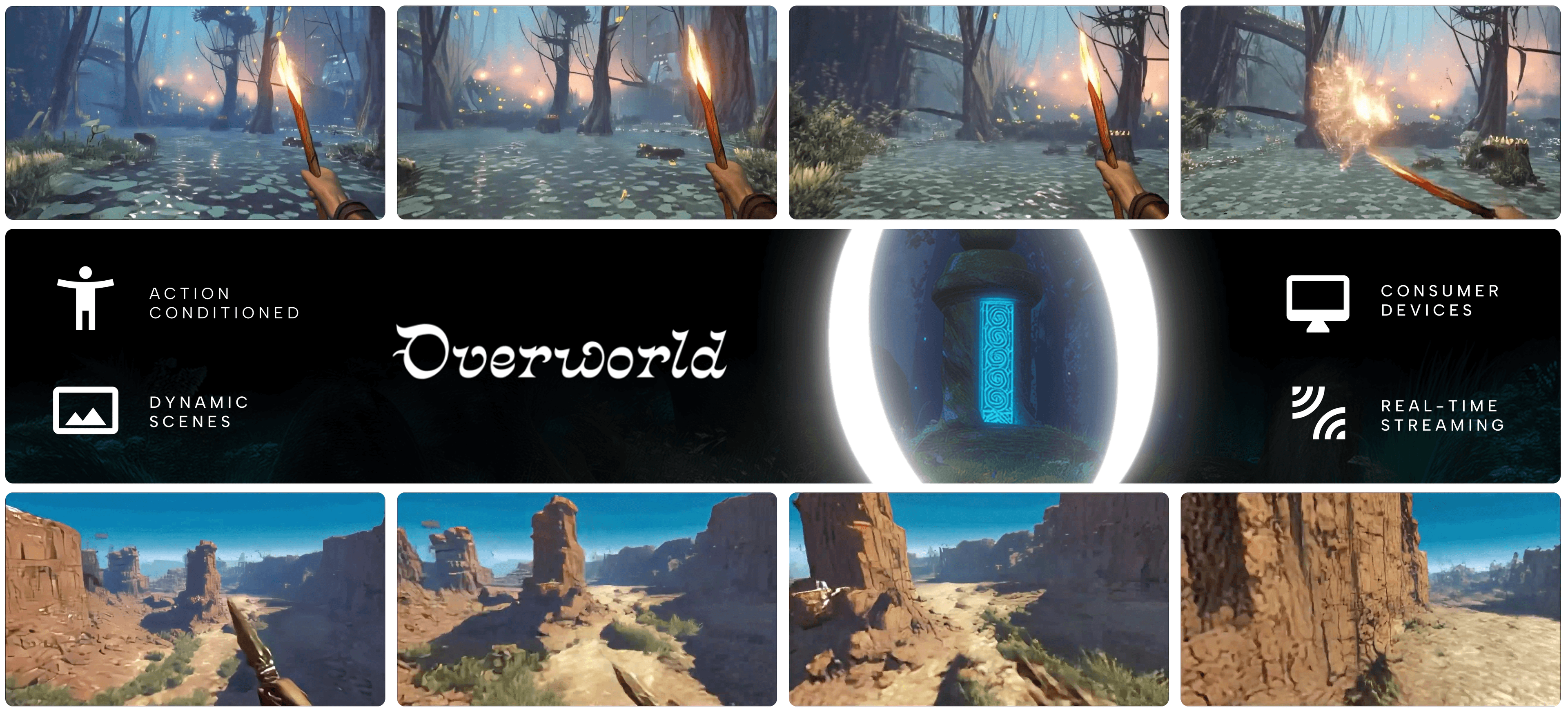
Autoregressive Rollouts
Real-time gameplay generated by Waypoint-1.5 on a single consumer GPU, conditioned on keyboard and mouse input.
Architecture
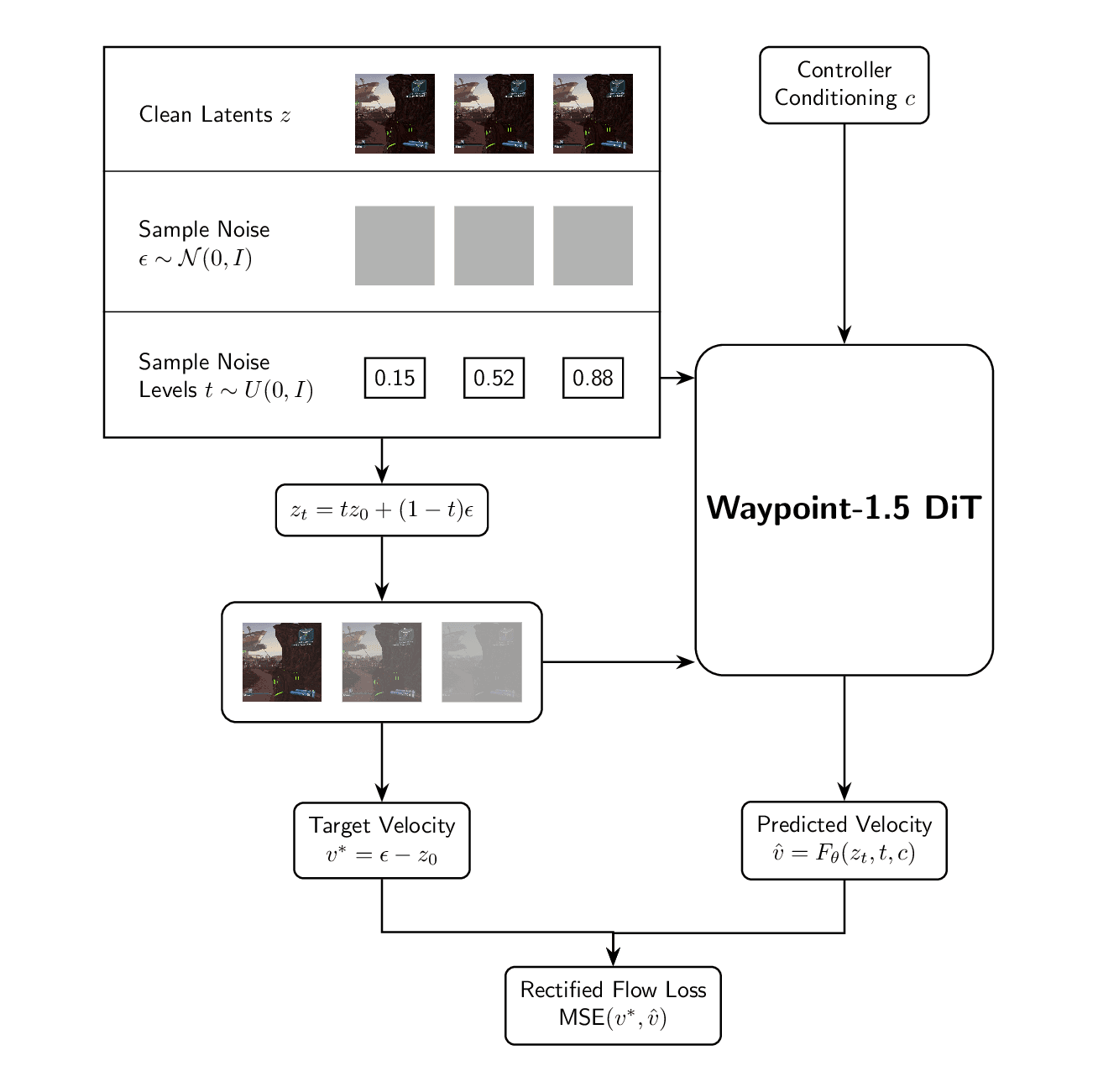
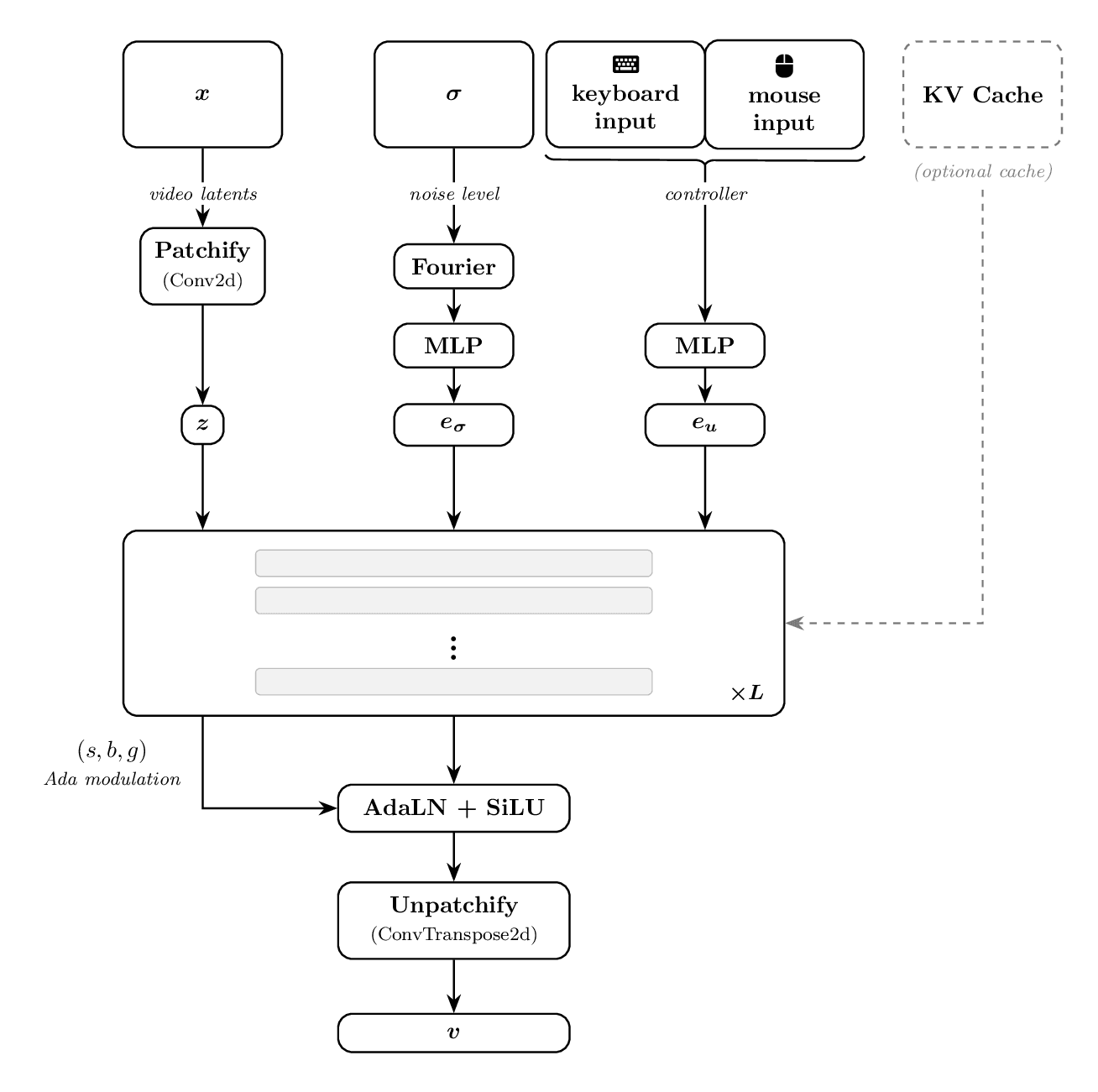
Waypoint-1.5 is built on a single-stream causal Diffusion Transformer trained with per-frame independent noise levels (Diffusion Forcing), then distilled to a 4-step model via custom Self-Forcing DMD.
Performance
Latent FPS across consumer GPUs at 512×1024 (high-res) and 256×512 (low-res) with INT8 quantization and BF16 baseline.
| GPU | 512×1024 INT8 | 512×1024 BF16 | 256×512 INT8 | 256×512 BF16 |
|---|---|---|---|---|
| RTX PRO 6000 Blackwell | 132.40 | 87.76 | 371.08 | 303.72 |
| RTX 5090 | 111.40 | 66.28 | 346.64 | 277.52 |
| RTX 4090 | 72.88 | 66.60 | 275.84 | 207.52 |
| RTX 5070 Ti | 59.68 | 39.96 | 270.48 | 178.56 |
| RTX 3090 Ti | 43.64 | 29.00 | 198.16 | 104.36 |
| RTX 3090 | 37.36 | 21.60 | 188.44 | 116.12 |
| RTX 5060 Ti | 31.92 | 17.72 | 162.08 | 85.68 |
| RTX 4060 Ti | 28.32 | 16.40 | 126.84 | 78.68 |
| RTX 3070 | 23.24 | OOM | 120.08 | OOM |
| RTX 3060 | 15.76 | 8.80 | 81.88 | 36.76 |
BibTeX
If you use Waypoint-1.5 in your research, please cite:
@misc{overworld2026waypoint15,
  title         = {Waypoint-1.5: A Real-Time Video World Model for Consumer Hardware},
  author        = {Rajit Rajpal and Shahbuland Matiana and Liew Wei Pyn and
                   Anmol Agarwal and Ryan Craig and Andrew Lapp and
                   Mithun Hunsur and Sami BuGhanem and Scottie Fox and
                   Aaron Sanders and Carson Poole and Irene Park and Dave Rossi and
                   Spencer Frazier and Louis Castricato},
  year          = {2026},
  eprint        = {2606.XXXXX},
  archivePrefix = {arXiv},
  primaryClass  = {cs.CV},
  url           = {https://arxiv.org/abs/2606.XXXXX}
}